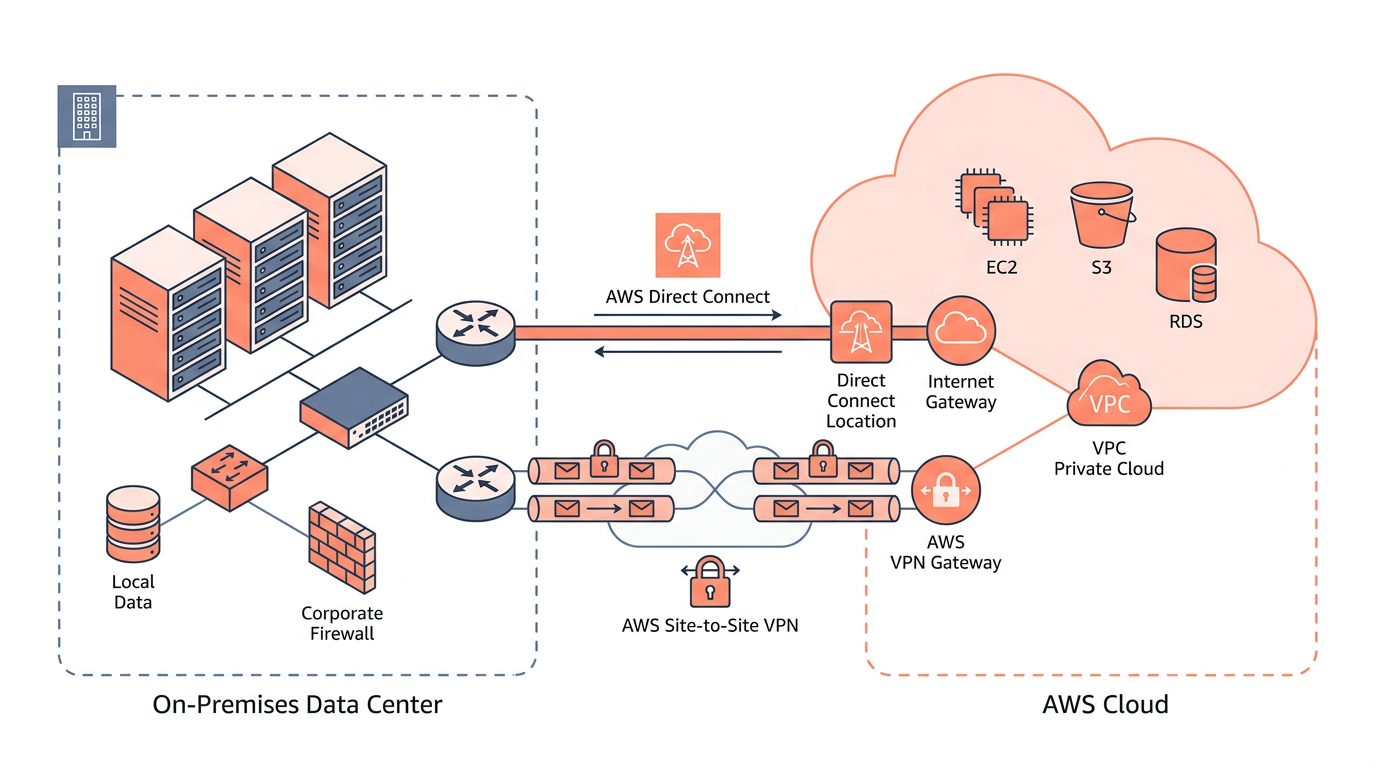
Hybrid cloud architecture lets organizations run workloads across on-premises data centers and AWS simultaneously, using secure, low-latency network links to make both environments behave as one. As of 2026, the majority of enterprise workloads still touch on-premises infrastructure in some form — whether for regulatory compliance, legacy system integration, or latency-sensitive operations. This article walks through the practical options, trade-offs, and design patterns for connecting your data center to AWS, with a focus on AWS Direct Connect and VPN-based approaches.
You will learn how each connectivity option works at a technical level, when to choose one over the other, how to combine them for resilience, and what a realistic hybrid architecture looks like end-to-end.
What Is Hybrid Cloud Architecture?
Hybrid cloud is a computing model that integrates on-premises infrastructure with one or more public cloud environments — in this case AWS — so that data and applications can move between them. It is not simply "some things on-prem, some things in the cloud." A true hybrid architecture requires consistent networking, identity, and security controls that span both environments.
Common drivers include:
- Data residency requirements — regulations like GDPR or sector-specific rules that restrict where certain data can be stored or processed.
- Legacy application dependencies — mainframes, ERP systems, or databases that cannot be lifted and shifted without significant re-engineering.
- Burst-to-cloud patterns — keeping baseline capacity on-premises while using AWS to absorb demand spikes.
- Gradual migration — running old and new versions of a system in parallel during a phased cutover.
The Two Core Connectivity Options: Direct Connect vs. VPN
AWS Direct Connect and AWS Site-to-Site VPN are the two primary mechanisms for connecting on-premises networks to AWS. They solve the same fundamental problem — private, routable connectivity between your data center and an Amazon VPC — but they differ significantly in performance, cost, setup time, and resilience characteristics.
| Feature | AWS Direct Connect | AWS Site-to-Site VPN |
|---|---|---|
| Transport | Dedicated private fiber | Encrypted tunnel over public internet |
| Bandwidth | 1 Gbps, 10 Gbps, 100 Gbps (hosted: 50 Mbps–10 Gbps) | Up to ~1.25 Gbps per tunnel |
| Latency | Consistent, low (sub-10 ms typical) | Variable (internet-dependent) |
| Encryption | Not encrypted by default (add MACsec or IPsec) | IPsec encrypted by default |
| Setup time | Weeks to months | Minutes to hours |
| Monthly cost | Port fee + data transfer (starts ~$0.30/hr for 1G) | ~$0.05/hr per VPN connection + data transfer |
| Redundancy | Requires second connection or VPN failover | Dual tunnels per connection (built-in) |
| Best for | Production, high-throughput, latency-sensitive | Dev/test, backup path, rapid deployment |
AWS Direct Connect
Direct Connect provides a dedicated, private network connection from your premises to AWS, bypassing the public internet entirely. You provision a port at one of AWS's 100+ Direct Connect locations worldwide, and your network provider runs a cross-connect to that port.
Key technical details:
- Uses BGP (Border Gateway Protocol) for dynamic routing. You advertise your on-premises CIDRs to AWS and receive VPC CIDRs in return.
- Supports two virtual interface types relevant to hybrid connectivity: Private VIFs (connect to a single VPC) and Transit VIFs (connect to an AWS Transit Gateway, enabling hub-and-spoke to many VPCs).
- Direct Connect Gateway lets you associate a single Direct Connect connection with VPCs in multiple AWS regions, which is critical for multi-region hybrid designs.
- MACsec (IEEE 802.1AE) encryption is available on dedicated 10G and 100G ports for organizations that require encryption at Layer 2 — useful when the physical path traverses a third-party carrier.
- SLA: AWS guarantees 99.9% availability for a single connection and 99.99% for redundant connections in the same or different locations.
A common mistake is provisioning a single Direct Connect connection and assuming it is highly available. A fiber cut, port failure, or facility outage will drop connectivity. Always pair a primary Direct Connect with either a second connection or a Site-to-Site VPN as a failover path.
AWS Site-to-Site VPN
Site-to-Site VPN creates an IPsec-encrypted tunnel between your on-premises customer gateway device and an AWS Virtual Private Gateway or Transit Gateway. It is the fastest way to establish hybrid connectivity and costs a fraction of Direct Connect.
Key technical details:
- Each VPN connection consists of two tunnels terminating in different AWS Availability Zones for redundancy. Both tunnels should be kept active using BGP (dynamic routing) rather than static routes.
- Supported IKE versions: IKEv1 and IKEv2. IKEv2 is recommended for modern deployments.
- Maximum throughput per tunnel is approximately 1.25 Gbps, though real-world throughput depends on the customer gateway device's crypto performance and internet path quality.
- Accelerated Site-to-Site VPN uses AWS Global Accelerator to route traffic over the AWS backbone rather than the public internet, reducing latency and jitter — a useful middle ground between standard VPN and Direct Connect.
- Compatible customer gateway devices include Cisco ASA/IOS, Palo Alto, Fortinet, pfSense, and many others. AWS provides downloadable configuration templates for most major vendors.
Combining Direct Connect and VPN for Resilience
The production-grade hybrid cloud pattern uses Direct Connect as the primary path and Site-to-Site VPN as the failover path. BGP route preferences (using AS path prepending or Local Preference) control which path carries traffic under normal conditions.
A typical failover design:
- Direct Connect carries all production traffic with a preferred BGP local preference.
- A Site-to-Site VPN is configured to the same Virtual Private Gateway or Transit Gateway.
- If Direct Connect fails, BGP reconverges and traffic automatically shifts to the VPN tunnel — typically within 30–60 seconds depending on BGP timers.
- When Direct Connect recovers, traffic shifts back automatically.
This pattern satisfies most enterprise RTO requirements without the cost of a second Direct Connect port.
AWS Transit Gateway: The Hub for Complex Hybrid Networks
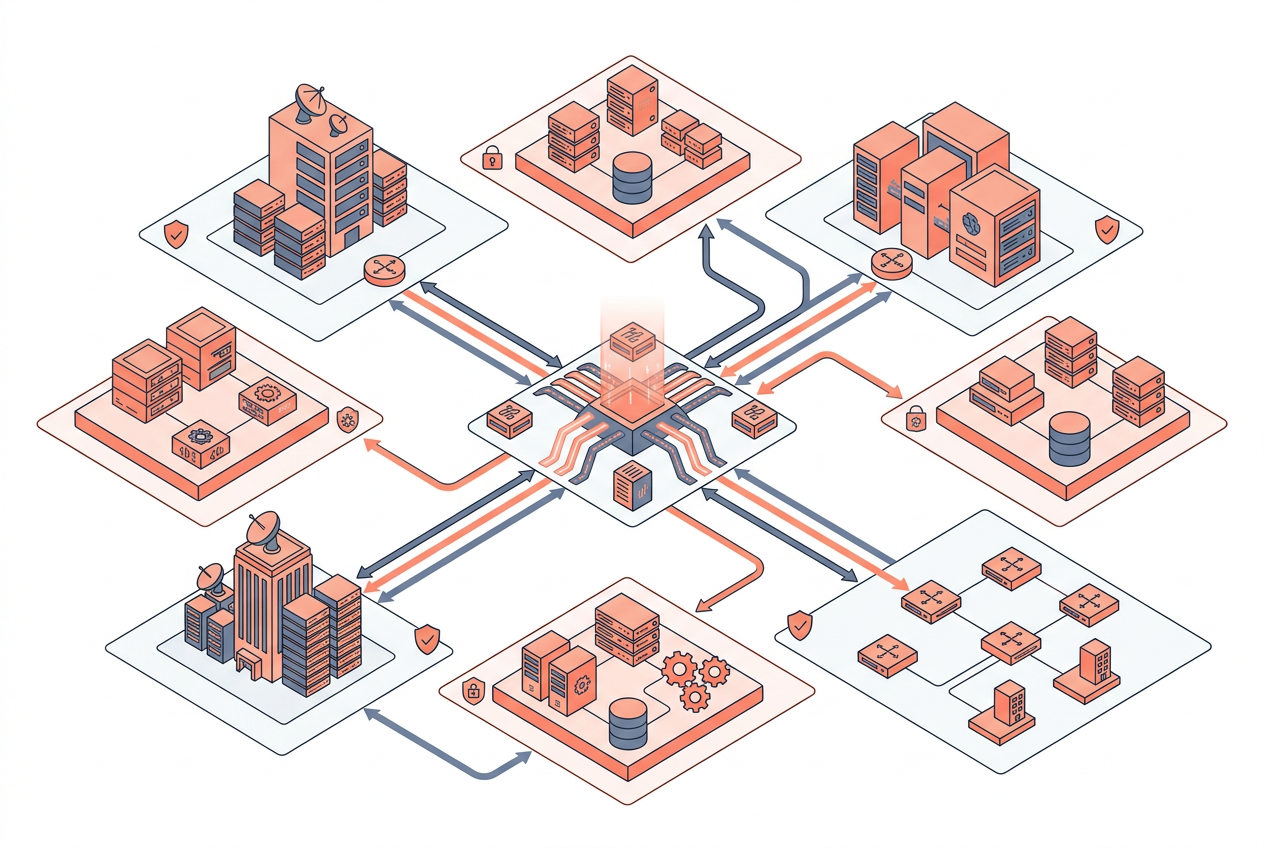
AWS Transit Gateway (TGW) acts as a regional network hub, allowing you to connect multiple VPCs, Direct Connect connections, and VPN tunnels through a single managed resource. Without TGW, connecting 10 VPCs to on-premises would require 10 separate VPN connections or 10 Private VIFs — a management nightmare.
With Transit Gateway:
- Attach all VPCs to the TGW. On-premises connects once via a Transit VIF on Direct Connect or a VPN attachment.
- Use TGW route tables to control which VPCs can communicate with on-premises and with each other (segmentation).
- Inter-region peering between Transit Gateways enables multi-region hybrid architectures without routing traffic back through on-premises.
- TGW supports up to 5,000 VPC attachments and 50 Gbps of bandwidth per VPC attachment.
For organizations with multiple AWS accounts (common in AWS Organizations setups), TGW can be shared across accounts using AWS Resource Access Manager (RAM).
DNS Resolution Across Hybrid Environments
Network connectivity alone is not enough — applications also need name resolution to work across the hybrid boundary. AWS Route 53 Resolver handles this with two components:
- Inbound Resolver Endpoints: Allow on-premises DNS servers to forward queries for AWS-hosted domains (e.g., private hosted zones, VPC-internal names) to Route 53.
- Outbound Resolver Endpoints: Allow AWS resources to forward queries for on-premises domains to your corporate DNS servers.
Both endpoint types use Elastic Network Interfaces (ENIs) deployed in your VPC subnets, and DNS traffic travels over the same Direct Connect or VPN path as your application traffic. Port 53 (UDP and TCP) must be open in your security groups and network ACLs.
Security Considerations
Hybrid connectivity expands your attack surface. Key controls to implement:
- Encrypt Direct Connect traffic using MACsec (Layer 2) or by running an IPsec VPN over the Direct Connect path (adds encryption but reduces throughput slightly).
- Use AWS Network Firewall or a third-party virtual appliance in a centralized inspection VPC attached to Transit Gateway to inspect all traffic entering from on-premises.
- Apply VPC security groups and network ACLs to limit which on-premises CIDRs can reach which AWS resources.
- Integrate with AWS IAM Identity Center (formerly SSO) and your on-premises Active Directory via AWS Directory Service or a trust relationship to maintain consistent identity across environments.
- Enable VPC Flow Logs and ship them to Amazon S3 or CloudWatch Logs for visibility into cross-environment traffic patterns.
Key Takeaways
- Direct Connect provides dedicated, low-latency, high-bandwidth connectivity but takes weeks to provision and costs significantly more than VPN.
- Site-to-Site VPN is fast to deploy, encrypted by default, and inexpensive — ideal for failover, dev/test, or lower-throughput production use cases.
- The production-grade hybrid pattern combines Direct Connect (primary) with Site-to-Site VPN (failover), using BGP to automate path switching.
- AWS Transit Gateway is the right hub for any hybrid environment with more than two or three VPCs, enabling centralized routing, segmentation, and multi-account connectivity.
- DNS resolution across the hybrid boundary requires Route 53 Resolver inbound and outbound endpoints — overlooking this is a common cause of application failures post-migration.
- Encryption is not automatic on Direct Connect — add MACsec or an IPsec overlay if your compliance requirements mandate encryption in transit over the physical path.
- Always design for redundancy from day one: a single Direct Connect connection without a failover path does not meet enterprise availability standards.
Frequently Asked Questions
How long does it take to set up AWS Direct Connect?
Setting up Direct Connect typically takes two to twelve weeks, depending on your colocation provider's cross-connect lead times and your network carrier's provisioning process. Hosted connections through an AWS Direct Connect Partner can sometimes be provisioned faster — occasionally within days — because the partner already has a port at the Direct Connect location.
Can I use both Direct Connect and VPN at the same time?
Yes, and this is the recommended approach for production environments. You configure BGP route preferences so Direct Connect carries traffic under normal conditions, and the VPN tunnel automatically takes over if the Direct Connect path fails. Both can be attached to the same Virtual Private Gateway or Transit Gateway.
What is the difference between a Private VIF and a Transit VIF on Direct Connect?
A Private VIF connects your Direct Connect port directly to a single Virtual Private Gateway, giving you access to one VPC. A Transit VIF connects to an AWS Transit Gateway, which can then route to many VPCs across multiple accounts and regions — making Transit VIF the right choice for any non-trivial hybrid architecture.
Is AWS Site-to-Site VPN traffic encrypted?
Yes. Site-to-Site VPN uses IPsec to encrypt all traffic in transit between your on-premises customer gateway and the AWS VPN endpoint. Direct Connect traffic is not encrypted by default and requires MACsec or an IPsec overlay if encryption is required.
How do I connect multiple AWS accounts to my on-premises network?
The standard pattern is to deploy AWS Transit Gateway in a central networking account, share it to other accounts via AWS Resource Access Manager, and connect on-premises via a single Direct Connect Transit VIF or VPN attachment to that TGW. This avoids duplicating connectivity in every account.
What bandwidth should I provision for Direct Connect?
Start by measuring your current peak egress from on-premises to the cloud workloads you plan to migrate, then add headroom for growth. A 1 Gbps dedicated connection is a common starting point for mid-sized enterprises. If you need more than 10 Gbps, you can use Link Aggregation Groups (LAGs) to bond multiple ports, or provision a 100 Gbps port at supported locations.
Does hybrid cloud architecture work across multiple AWS regions?
Yes. A Direct Connect Gateway lets you associate one Direct Connect connection with Virtual Private Gateways or Transit Gateways in multiple regions. For Transit Gateway-based designs, inter-region TGW peering allows traffic to flow between regions over the AWS backbone without hairpinning through on-premises, which is both faster and more cost-effective.
Draw this in seconds with draft1. Describe your architecture in plain English and draft1 generates an editable AWS/cloud diagram plus documentation — no dragging boxes around. Try it free.
Ready-made templates
Start from a working diagram instead of a blank canvas:
- Global API Management Architecture With Multi-Region Deployment — free, editable in draw.io
- AWS VPC Multi-AZ Architecture — free, editable in draw.io
- Cloud Application Architecture Diagram — free, editable in draw.io
Draw this in ~20 seconds
Describe your own version of this architecture and draft1 generates an editable draw.io diagram — boxes, arrows, labels, the lot.
Generate this diagram free ➔Free demo — no signup. Then 3 free diagrams with an account, no card.