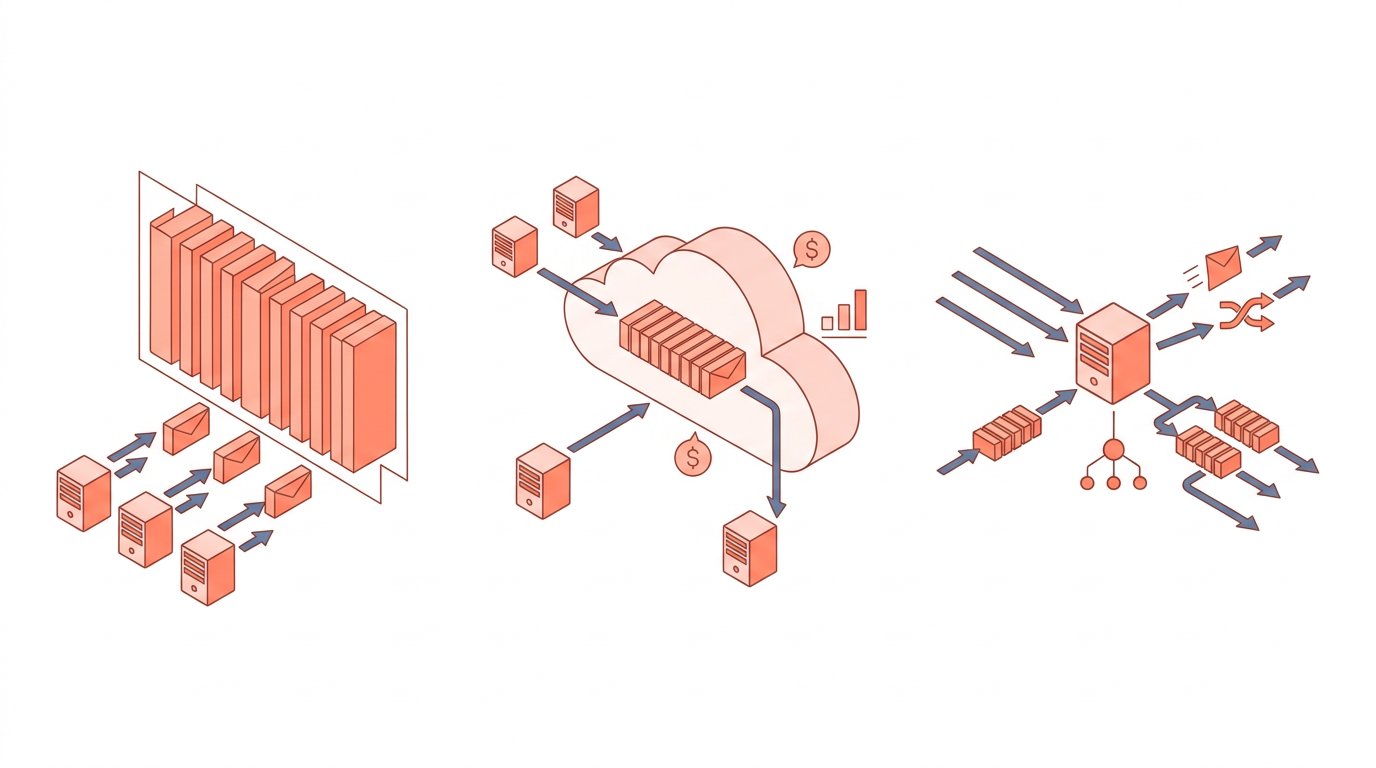
Choosing the right message queue architecture directly determines whether your distributed system scales gracefully or collapses under load. In 2026, three technologies dominate the conversation: Apache Kafka, Amazon SQS, and RabbitMQ — each built on fundamentally different assumptions about what "messaging" means. This article breaks down their architectures, trade-offs, and ideal use cases so you can make an informed decision rather than defaulting to whatever your team used last time.
Whether you're designing a real-time analytics pipeline, decoupling microservices, or offloading background jobs, the choice between Kafka vs SQS vs RabbitMQ has lasting consequences for throughput, operational burden, cost, and consumer flexibility. By the end of this article you'll understand the architectural philosophy behind each system, where each one genuinely excels, and how to map your requirements to the right tool.
What Is Message Queue Architecture?
Message queue architecture is a pattern where producers publish messages to an intermediary broker, and consumers read from that broker asynchronously — decoupling the two sides so neither needs to know about the other. The broker absorbs bursts, provides durability, and enables fan-out, retry logic, and ordered processing depending on its design.
The three systems covered here represent three distinct philosophies:
- Kafka is a distributed, append-only log — messages are retained and can be replayed.
- SQS is a fully managed queue — messages are deleted after successful consumption.
- RabbitMQ is a message broker built on the AMQP protocol — it routes messages through exchanges and queues with rich binding rules.
Understanding this distinction is not academic. It determines whether you can replay events, how you handle consumer failures, and what operational skills your team needs.
Apache Kafka: The Distributed Log
Kafka treats every message as a durable, ordered log entry that any number of consumers can read independently, at their own pace. This is its defining characteristic and the source of both its power and its complexity.
Kafka organizes messages into topics, which are split into partitions. Each partition is an ordered, immutable sequence of records stored on disk. Producers append to the end; consumers track their position using an offset. Crucially, consuming a message does not delete it — messages are retained for a configurable period (default 7 days, but production deployments often set this to 30 days or longer).
Key architectural properties:
- Throughput: Kafka is designed for high throughput. A single broker can handle hundreds of thousands of messages per second. Clusters routinely sustain millions of messages per second.
- Consumer groups: Multiple independent consumer groups can each read the same topic from the beginning, enabling fan-out without message duplication concerns.
- Ordering: Messages within a partition are strictly ordered. Cross-partition ordering is not guaranteed.
- Replication: Topics are replicated across brokers (configurable replication factor, typically 3). Producers can require acknowledgment from all in-sync replicas (
acks=all) for durability. - Operational complexity: Kafka requires ZooKeeper (or KRaft mode since 2.8, now the default in 2026) for cluster coordination. Managed services like Amazon MSK or Confluent Cloud reduce this burden significantly.
Ideal for: Event sourcing, real-time analytics pipelines, audit logs, change data capture (CDC), and any scenario where multiple independent consumers need to process the same stream.
Not ideal for: Simple task queues, low-volume workloads where operational overhead isn't justified, or teams without Kafka expertise.
Amazon SQS: The Fully Managed Queue
Amazon SQS is a serverless, fully managed queue service that requires zero infrastructure management and scales automatically to handle virtually any message volume. It is the lowest-friction option for AWS-native workloads.
SQS offers two queue types:
- Standard queues: At-least-once delivery, best-effort ordering, nearly unlimited throughput. Messages may occasionally be delivered more than once, so consumers must be idempotent.
- FIFO queues: Exactly-once processing, strict ordering within a message group, up to 3,000 messages per second with batching (300 without). FIFO queues are more expensive and have lower throughput ceilings.
Key architectural properties:
- Visibility timeout: When a consumer reads a message, it becomes invisible to other consumers for a configurable period (default 30 seconds, max 12 hours). If not deleted within that window, it reappears — enabling automatic retry.
- Dead-letter queues (DLQ): Messages that fail processing repeatedly are automatically moved to a DLQ after a configurable
maxReceiveCount. - Message size: Up to 256 KB per message. Larger payloads require storing the body in S3 and passing a reference.
- Retention: Messages are retained for up to 14 days and deleted after successful consumption. There is no replay capability.
- Long polling: Consumers can poll for up to 20 seconds, reducing empty responses and cost.
Ideal for: Decoupling AWS Lambda functions, background job processing, fan-out with SNS → SQS subscriptions, and teams that want zero operational overhead.
Not ideal for: Event replay, high-throughput streaming, or scenarios requiring multiple independent consumers on the same message stream without SNS fan-out.
RabbitMQ: The Flexible Message Broker
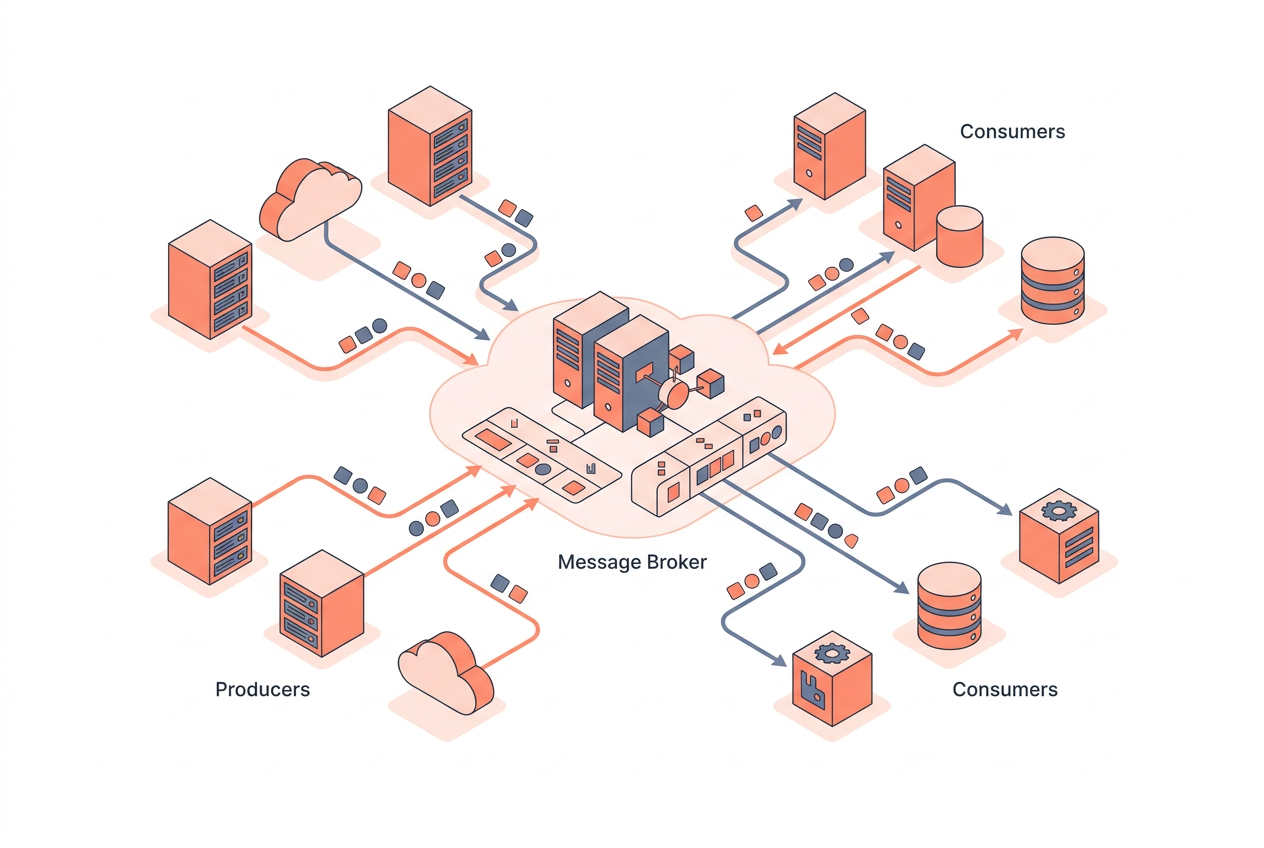
RabbitMQ is a mature, protocol-rich broker that excels at complex routing scenarios — delivering messages to the right queue based on topic patterns, headers, or direct bindings. It implements AMQP 0-9-1 natively and supports MQTT and STOMP via plugins.
RabbitMQ's routing model is its differentiator. Producers publish to exchanges, not queues. Exchanges route messages to one or more queues based on binding rules:
- Direct exchange: Routes by exact routing key match.
- Topic exchange: Routes by wildcard pattern (e.g.,
order.*.created). - Fanout exchange: Broadcasts to all bound queues.
- Headers exchange: Routes based on message header attributes.
Key architectural properties:
- Push-based delivery: RabbitMQ pushes messages to consumers (via channels), unlike Kafka's pull model. This reduces latency but requires careful prefetch count tuning to avoid overwhelming slow consumers.
- Acknowledgments: Consumers send explicit
ackornack. Unacknowledged messages are requeued or dead-lettered. - Clustering and quorum queues: RabbitMQ clusters replicate queues across nodes using quorum queues (Raft-based, recommended since 3.8) for durability. Classic mirrored queues are deprecated as of 2026.
- Throughput: Typically tens of thousands of messages per second per node — lower than Kafka but sufficient for most enterprise workloads.
- Management UI: RabbitMQ ships with a built-in management plugin at port 15672, providing real-time queue depth, consumer counts, and message rates.
Ideal for: Complex routing logic, request-reply patterns, RPC over messaging, polyglot environments (many language clients), and workloads that need fine-grained per-message acknowledgment.
Not ideal for: Very high throughput streaming, event replay, or teams that want fully managed infrastructure without operational involvement (though Amazon MQ for RabbitMQ reduces this).
Kafka vs SQS vs RabbitMQ: Side-by-Side Comparison
| Dimension | Apache Kafka | Amazon SQS | RabbitMQ |
|---|---|---|---|
| Delivery model | Pull (consumer-driven) | Pull (long poll) | Push (broker-driven) |
| Message retention | Configurable (days/forever) | Up to 14 days, deleted on consume | Deleted on ack |
| Replay support | Yes (by resetting offset) | No | No |
| Ordering | Per-partition | FIFO queues only | Per-queue |
| Max throughput | Millions msg/sec (cluster) | Unlimited (Standard) | Tens of thousands/sec |
| Exactly-once | Yes (transactions + idempotent producer) | Yes (FIFO only) | Yes (with quorum queues + publisher confirms) |
| Managed option | Amazon MSK / Confluent Cloud | Native AWS service | Amazon MQ / CloudAMQP |
| Operational complexity | High | None | Medium |
| Routing flexibility | Low (topic/partition) | Low | High (exchanges + bindings) |
| Typical use case | Event streaming, CDC, analytics | Task queues, Lambda triggers | Microservice decoupling, RPC |
How to Choose: A Decision Framework
The right choice depends on three questions: Do you need replay? Do you need complex routing? How much operational overhead can you absorb?
Use this framework:
-
Need event replay or multiple independent consumers on the same stream? → Kafka. Nothing else in this comparison supports replaying historical events to a new consumer group.
-
Running on AWS and want zero infrastructure management? → SQS. Pair it with SNS for fan-out. Use FIFO queues when ordering matters.
-
Need complex routing logic, RPC patterns, or AMQP protocol support? → RabbitMQ. Its exchange model handles scenarios that would require awkward workarounds in Kafka or SQS.
-
High throughput streaming with analytics? → Kafka, potentially with ksqlDB or Apache Flink for stream processing on top.
-
Simple background job queue on AWS? → SQS Standard with a Lambda consumer. This is the lowest-cost, lowest-effort path.
Key Takeaways
- Kafka is a log, not a queue — its defining feature is durable, replayable, ordered event storage, not just message delivery.
- SQS deletes messages after consumption — there is no native replay; if you need it, store events in S3 or use Kafka instead.
- RabbitMQ's exchange model enables routing flexibility that neither Kafka nor SQS can match without significant application-level workarounds.
- Operational burden scales with power: SQS requires no ops, RabbitMQ requires moderate ops, Kafka requires significant expertise (or a managed service budget).
- Exactly-once delivery is achievable in all three, but the mechanisms differ — Kafka uses idempotent producers and transactions, SQS uses FIFO queues, RabbitMQ uses publisher confirms with quorum queues.
- Throughput ceilings matter at scale: SQS Standard is effectively unlimited, Kafka clusters scale horizontally to millions of messages per second, RabbitMQ tops out at tens of thousands per node.
- Hybrid architectures are common: Many production systems use Kafka for the event backbone and SQS for task queues at the edges — these tools are not mutually exclusive.
Frequently Asked Questions
Is Kafka always better than SQS for high-throughput workloads?
Not necessarily. SQS Standard has no published throughput ceiling and scales automatically, making it competitive for pure task-queue workloads. Kafka's advantage appears when you need replay, stream processing, or multiple independent consumer groups — not raw throughput alone.
Can SQS replace Kafka for event sourcing?
No. SQS deletes messages after consumption and has no offset concept, so you cannot replay events to a new consumer. Event sourcing requires durable, replayable storage — use Kafka, or store events in a database and use Kafka or Kinesis as the transport layer.
What is the message size limit for each system?
SQS supports up to 256 KB per message (larger payloads require S3 offloading). Kafka's default maximum is 1 MB (message.max.bytes), configurable up to gigabytes with performance trade-offs. RabbitMQ has no hard limit by default, but large messages degrade performance and memory usage significantly.
When should I use RabbitMQ over SQS?
Use RabbitMQ when you need protocol flexibility (AMQP, MQTT, STOMP), complex routing via topic or header exchanges, or request-reply (RPC) patterns. SQS is simpler and cheaper for straightforward AWS-native task queues but lacks RabbitMQ's routing expressiveness.
Does Kafka support exactly-once semantics?
Yes. Kafka has supported exactly-once semantics (EOS) since version 0.11 (released in 2017) through idempotent producers and transactional APIs. In 2026, EOS is stable and widely used in production, though it adds latency and requires careful consumer-side configuration.
What is a dead-letter queue and which systems support it?
A dead-letter queue (DLQ) is a secondary queue where messages are sent after repeated processing failures. All three systems support it: SQS has native DLQ configuration via maxReceiveCount; RabbitMQ uses dead-letter exchanges (DLX); Kafka achieves similar behavior through application-level logic or frameworks like Spring Kafka's DeadLetterPublishingRecoverer.
How do managed services change the Kafka vs SQS decision?
Managed Kafka services like Amazon MSK and Confluent Cloud significantly reduce Kafka's operational burden, making it viable for teams without deep Kafka expertise. However, managed Kafka still costs more than SQS for low-to-medium volume workloads. Run a cost model against your expected message volume and retention requirements before committing.
Draw this in seconds with draft1. Describe your architecture in plain English and draft1 generates an editable AWS/cloud diagram plus documentation — no dragging boxes around. Try it free.
Ready-made templates
Start from a working diagram instead of a blank canvas:
- Cloud Infrastructure Architecture Diagram — free, editable in draw.io
- Cloud vs On-Premise Infrastructure Architecture Diagram — free, editable in draw.io
- AWS EKS Cluster Architecture — free, editable in draw.io
Draw this in ~20 seconds
Describe your own version of this architecture and draft1 generates an editable draw.io diagram — boxes, arrows, labels, the lot.
Generate this diagram free ➔Free demo — no signup. Then 3 free diagrams with an account, no card.