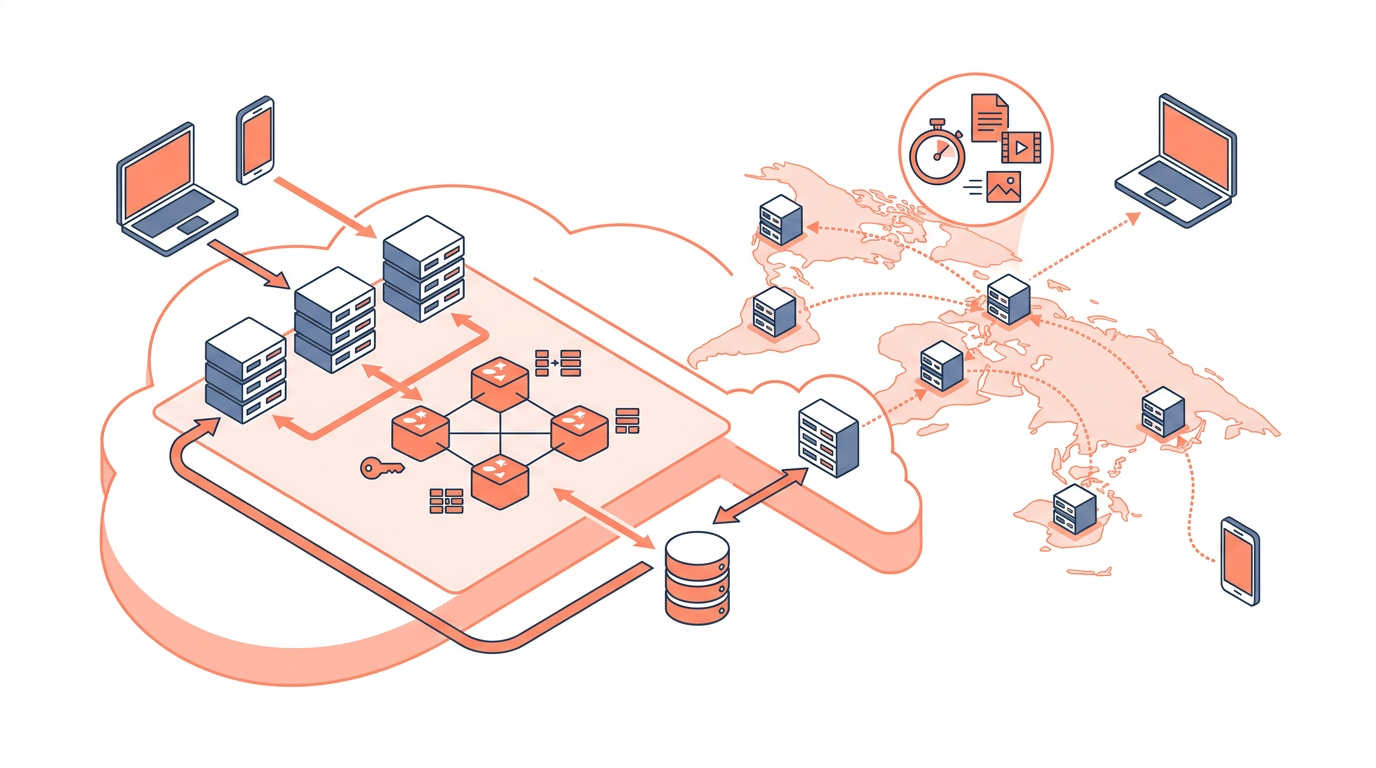
Caching is the single most effective technique for reducing latency and database load in distributed systems. Redis and CloudFront solve different caching problems — Redis handles server-side, application-layer caching while CloudFront is a CDN that caches content at the network edge — and understanding when to use each (or both) is essential for designing scalable systems. This article walks through the core caching strategies, explains where each tool fits, and gives concrete examples you can apply immediately.
Whether you're designing a new service or diagnosing a slow one, the decision between Redis, CloudFront, or a layered combination of both comes down to what you're caching, who is requesting it, and how often the data changes. By the end of this article you'll have a clear mental model for making that decision.
What Is a Caching Strategy and Why Does It Matter?
A caching strategy is the set of rules that governs how data is stored, retrieved, invalidated, and expired in a cache layer. Choosing the wrong strategy — or skipping caching entirely — is one of the most common causes of unnecessary database costs, high p99 latency, and poor user experience at scale.
In 2026, most production systems on AWS use at least two cache layers: an origin cache (typically Redis via Amazon ElastiCache or Amazon MemoryDB) and an edge cache (typically Amazon CloudFront). These layers are complementary, not competing. Getting both right means your database only sees traffic that genuinely requires a fresh read.
Redis vs. CloudFront: Core Differences
Redis and CloudFront operate at fundamentally different layers of the stack, which is why comparing them directly can be misleading.
| Dimension | Redis (ElastiCache / MemoryDB) | Amazon CloudFront |
|---|---|---|
| Cache location | Inside your VPC, close to your app servers | AWS edge locations (500+ PoPs globally) |
| Primary use case | Application-layer data caching, sessions, queues | Static assets, API responses, HTML pages |
| Protocol | TCP (RESP protocol, port 6379 / 6380 TLS) | HTTPS (port 443) |
| Invalidation mechanism | TTL, explicit DEL/UNLINK, keyspace events | Cache-Control headers, CreateInvalidation API |
| Max object size | 512 MB per key | 30 GB per object |
| Latency profile | Sub-millisecond within same AZ | ~1–50 ms to nearest PoP |
| Auth model | AUTH command, IAM (MemoryDB), VPC security groups | Signed URLs, signed cookies, OAC for S3 |
| Cost model | Instance-hours + data transfer | Requests + data transfer out |
The key insight: CloudFront caches responses between your origin and the internet, while Redis caches data between your application and your database or downstream services. They sit at different points in the request path.
The Four Core Caching Patterns
Cache-Aside (Lazy Loading)
Cache-aside is the most common Redis pattern: your application checks the cache first, and on a miss it fetches from the database, writes the result to Redis, then returns it to the caller.
1. App receives request for user profile (user_id=42)
2. App calls Redis: GET user:42
3. Cache miss → App queries PostgreSQL
4. App writes result to Redis: SET user:42 <json> EX 300
5. App returns data to caller
Trade-offs: Simple to implement and only caches data that's actually requested. The downside is the cold-start penalty — the first request after a cache miss (or after a deployment) hits the database. Under a thundering-herd scenario, hundreds of concurrent requests can all miss simultaneously and hammer the DB. Mitigate this with a probabilistic early expiration technique or a distributed lock (Redis SET NX pattern) to let only one request refresh the key.
Write-Through
Write-through caches update Redis synchronously every time the database is written, so the cache is always warm. This eliminates cold-start misses but means every write pays double latency (DB + Redis). It's a good fit for user session data or shopping cart contents where reads are frequent and you can't tolerate stale data.
Write-Behind (Write-Back)
Write-behind writes to Redis first and asynchronously flushes to the database, trading durability for write throughput. This pattern is appropriate for high-frequency counters (page views, likes) where losing a few seconds of data is acceptable. Amazon MemoryDB (Redis-compatible, with a durable transaction log) reduces the risk here compared to plain ElastiCache.
Read-Through
Read-through delegates cache population to the cache layer itself rather than the application. ElastiCache doesn't natively support this, so it's typically implemented via a caching library (e.g., Spring Cache, Django cache framework) that wraps the data access layer transparently.
When to Use Redis: Application-Layer Caching
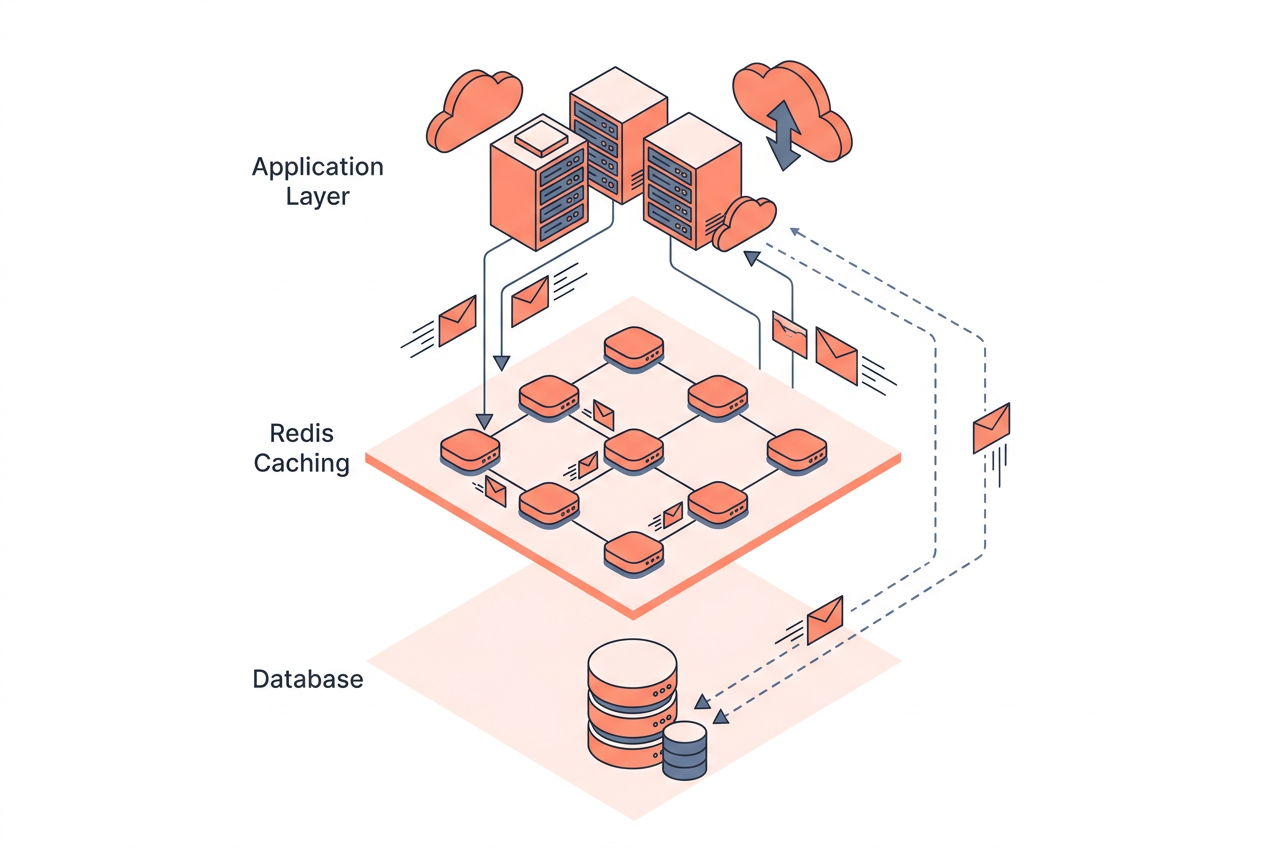
Redis is the right tool when the data you need to cache is:
- User-specific or session-specific — CloudFront cannot cache per-user data without significant complexity (Vary headers, signed URLs). Redis stores session tokens, user preferences, and authorization decisions keyed by user ID or session token.
- Computed or aggregated — Expensive SQL aggregations (e.g., a leaderboard, a recommendation list, a dashboard summary) should be computed once and stored in Redis with a TTL that matches your acceptable staleness window.
- Frequently mutated — If data changes every few seconds (inventory counts, bid prices), CloudFront's minimum TTL of 0 seconds is technically possible but operationally painful. Redis handles sub-second TTLs and atomic increments (
INCR,INCRBY) natively. - Structured — Redis supports strings, hashes, sorted sets, lists, streams, and more. A leaderboard built on a sorted set (
ZADD,ZRANGE) is a canonical example that would be impossible to replicate in a CDN.
Practical example: An e-commerce product page fetches price, stock level, and seller rating. Price changes every few minutes, stock changes every few seconds, and seller rating changes daily. A sensible Redis strategy: cache price with EX 120, stock with EX 10, and seller rating with EX 86400. Each key has an independent TTL matched to its volatility.
When to Use CloudFront: Edge Caching
CloudFront is the right tool when:
- Content is the same for all (or most) users — Static assets (JS, CSS, images, fonts), public API responses, and pre-rendered HTML are ideal. CloudFront's cache hit ratio directly reduces origin load and improves global latency.
- Geographic distribution matters — CloudFront's 500+ points of presence mean a user in Tokyo gets cached content from a Tokyo edge node, not from
us-east-1. Redis in a single region cannot replicate this without a Global Datastore (ElastiCache) or MemoryDB multi-region, which adds cost and complexity. - You want to absorb DDoS traffic at the edge — CloudFront integrated with AWS Shield and AWS WAF can block malicious traffic before it reaches your origin, something Redis cannot do.
- You're serving large binary objects — Video segments (HLS/DASH), PDFs, and large images belong in CloudFront + S3, not Redis.
Practical example: A news site serves article HTML. The article is the same for every anonymous visitor. Set Cache-Control: public, max-age=300, stale-while-revalidate=60 on the origin response. CloudFront caches the page for 5 minutes and serves stale content for an additional 60 seconds while it revalidates in the background. Database load drops by 95%+ for popular articles.
Cache invalidation with CloudFront: Use CreateInvalidation via the AWS CLI or SDK to purge specific paths (/articles/breaking-news). Invalidations complete in under 60 seconds globally. For high-frequency invalidations, consider versioned URLs (/assets/app.v3f9a2.js) instead — they never need invalidation because the filename changes with each deploy.
Layering Redis and CloudFront Together
The most resilient architectures use both layers. A typical request path looks like this:
User → CloudFront Edge → (cache miss) → ALB → App Server → Redis → (cache miss) → RDS
CloudFront handles the first line of defense for cacheable, public content. Redis handles the second line for dynamic, personalized, or frequently-changing data that CloudFront can't cache effectively.
Example: API response caching with both layers
A /api/v1/products/featured endpoint returns the same 20 products for all anonymous users. Set Cache-Control: public, max-age=60 so CloudFront caches it for 60 seconds. Behind CloudFront, the app server checks Redis for the featured_products key (TTL 120 seconds). If Redis misses, the app queries the database and repopulates Redis. The database only receives traffic every 2 minutes at most, regardless of global request volume.
For authenticated endpoints, strip the Authorization header from CloudFront's cache key (or use a CloudFront Function to normalize it), and rely entirely on Redis for per-user caching. Never cache authenticated responses in CloudFront without careful Vary-header configuration — you risk serving one user's data to another.
Key Takeaways
- Redis and CloudFront are complementary, not alternatives — use CloudFront for public, edge-cacheable content and Redis for application-layer, user-specific, or structured data.
- Match TTL to data volatility: short TTLs for inventory and prices, long TTLs for static assets and rarely-changing reference data.
- Cache-aside is the safest starting pattern for Redis; add write-through or write-behind only when you have a specific need (always-warm cache or high write throughput).
- Versioned asset URLs (
app.v3f9a2.js) eliminate the need for CloudFront invalidations on static assets and are a best practice in 2026 CI/CD pipelines. - Never cache authenticated, user-specific responses in CloudFront without explicit Vary-header or cache-key configuration — the risk of data leakage is real.
- Amazon MemoryDB is preferable to ElastiCache when you need Redis compatibility plus durability (write-behind patterns, primary data store use cases).
- Thundering herd is the most common Redis failure mode at scale — use probabilistic expiration or a distributed lock to prevent simultaneous cache-miss storms.
Frequently Asked Questions
What is the difference between Redis and CloudFront caching?
Redis is an in-memory data store that caches data inside your application infrastructure, typically between your app servers and your database. CloudFront is a CDN that caches HTTP responses at edge locations globally, between your origin servers and end users. They operate at different layers and are designed to be used together.
When should I use Redis instead of a local in-memory cache?
Use Redis when you have multiple application server instances that need to share cache state, or when you need the cache to survive an application restart. A local in-memory cache (e.g., a Python dict or a JVM ConcurrentHashMap) is faster but is isolated to a single process and lost on restart.
How do I invalidate CloudFront cache entries programmatically?
Call the CreateInvalidation API with the distribution ID and a list of paths (e.g., /articles/*). Each invalidation request can include up to 3,000 paths, and the first 1,000 invalidation paths per month are free. For high-frequency changes, versioned URLs are more cost-effective than repeated invalidations.
Can CloudFront cache API responses, not just static files?
Yes. CloudFront can cache any HTTP response, including JSON API responses. Configure a Cache Policy that includes only the headers and query strings relevant to your cache key, and ensure your origin sets appropriate Cache-Control headers. Avoid caching responses that include user-specific data unless you've carefully scoped the cache key.
What Redis eviction policy should I use for a cache workload?
For a pure cache (data that can always be re-fetched from the database), use allkeys-lru or allkeys-lfu. allkeys-lru evicts the least-recently-used key when memory is full; allkeys-lfu evicts the least-frequently-used key, which performs better for workloads with a hot subset of keys. Avoid noeviction for cache workloads — it causes write errors when memory is exhausted.
How does Amazon MemoryDB differ from ElastiCache for Redis?
MemoryDB stores data durably in a Multi-AZ transaction log, making it suitable as a primary database, not just a cache. ElastiCache for Redis is optimized for caching use cases where data can be re-fetched from a source of truth. MemoryDB costs more but provides RPO of zero and RTO in seconds, which matters for write-behind caching patterns.
Is it expensive to run both Redis and CloudFront?
CloudFront pricing is based on data transfer out and request count, and is generally very cost-effective for high-traffic public content — the savings on origin compute and database costs typically outweigh the CDN cost. Redis (ElastiCache) is priced by instance-hour; a cache.r7g.large node in us-east-1 runs approximately $0.166/hour as of 2026. For most production workloads, the database cost savings from Redis far exceed the ElastiCache instance cost.
Draw this in seconds with draft1. Describe your architecture in plain English and draft1 generates an editable AWS/cloud diagram plus documentation — no dragging boxes around. Try it free.
Ready-made templates
Start from a working diagram instead of a blank canvas:
- Redis Caching Strategies — free, editable in draw.io
- Containerized Application with Database and Geospatial Services Diagram — free, editable in draw.io
Draw this in ~20 seconds
Describe your own version of this architecture and draft1 generates an editable draw.io diagram — boxes, arrows, labels, the lot.
Generate this diagram free ➔Free demo — no signup. Then 3 free diagrams with an account, no card.